> For the complete documentation index, see [llms.txt](https://support.portsip.com/llms.txt). Markdown versions of documentation pages are available by appending `.md` to page URLs; this page is available as [Markdown](https://support.portsip.com/portsip-communications-solution/configuring-sip-trunks/vonage-sip-trunk/configuring-vonage-ip-authentication-trunk.md).
# Configuring Vonage IP Authentication Trunk
Before proceeding with the next steps, you need to [purchase a DID on the Vonage platform](/portsip-communications-solution/configuring-sip-trunks/vonage-sip-trunk/purchase-a-did-on-vonage-platform.md).
### Create a SIP Trunk on the Vonage Platform
You can also refer to the [official Vonage documentation](https://developer.vonage.com/en/sip/sip-dashboard?source=sip) for additional details on SIP trunk configuration.
***
#### Step 1: Create a New SIP Trunk
1. Sign in to the **Vonage Dashboard**.
2. Navigate to **Build & Manage > SIP**.
3. By default, Vonage provides a pre-created SIP trunk.
* You may click the **Settings** icon to modify it, or
* Click **Create New** to create a new SIP trunk.
4. In this guide, we will create a new SIP trunk.
5. Click **Create New**, enter a domain name for the trunk (for example, `portsip`), and then click **Create**.
6. Once the SIP trunk is successfully created, you are automatically redirected to the **Trunk Details** page.
***
#### Step 2: Configure Outbound Calling (IP Authentication)
1. On the **Trunk Details** page, locate the **Outbound Calling** section.
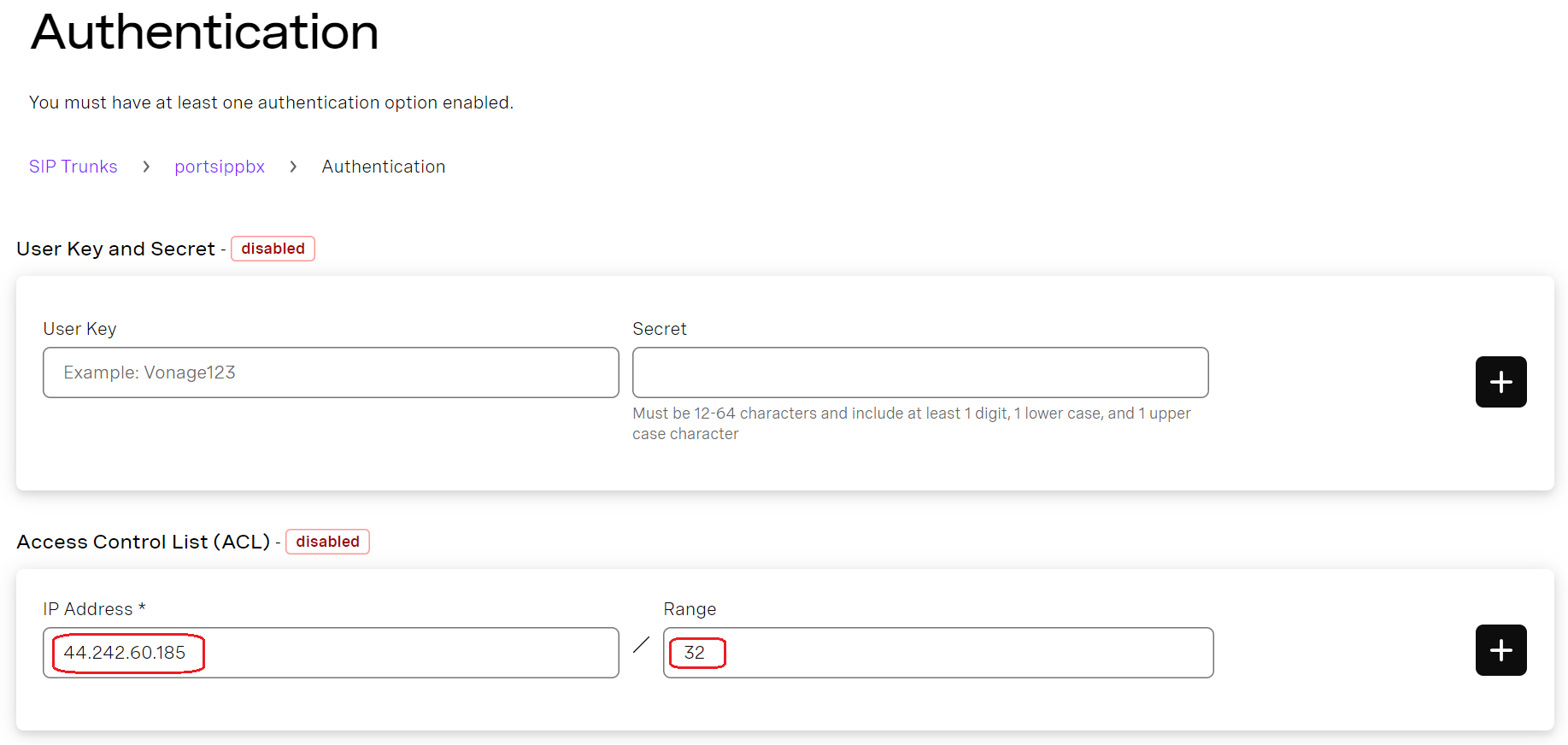
2. Click **Add Authentication**.\
You will be redirected to the **Authentication** page.
3. Under **Access Control List (ACL)**:
* **IP Address**: Enter your PortSIP PBX **static public IP address**
* **Range**: Enter `32` (single IP address)
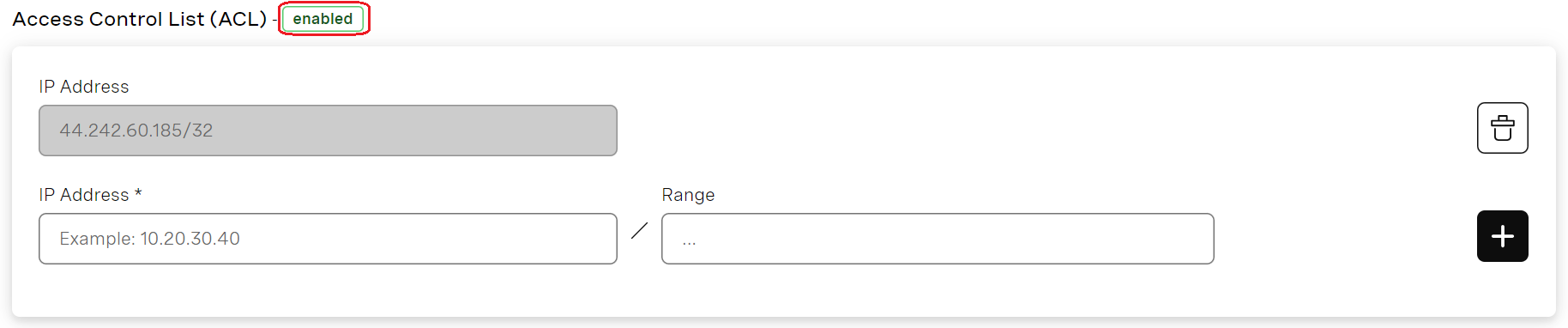
4. Save the configuration.
6. The **Access Control List (ACL)** section will appear **enabled (green)**, indicating that **IP-based authentication** is active.
> **Important**
>
> * **ACL (IP authentication) and User Key / Secret authentication are mutually exclusive.**
> * If you enable ACL authentication, **do not configure a User Key and Secret**, as both methods cannot be enabled at the same time.
7. Click **Back** to return to the **Trunk Details** page.
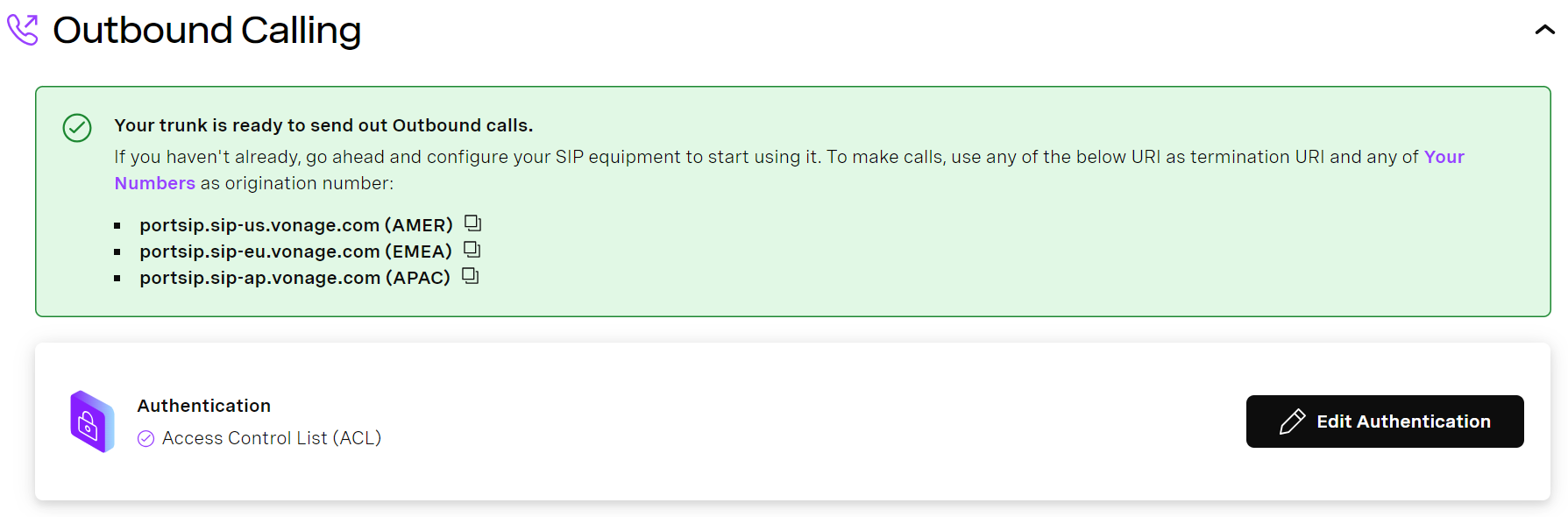
On the Trunk Details page, **Outbound Calling** should now be displayed as **Ready**.
***
#### Step 3: Note the Vonage SIP Trunk Domain
On the Trunk Details page, copy and save the **Vonage SIP trunk domain**.\
Choose the domain closest to your PortSIP PBX location for optimal latency:
* `portsip.sip-us.vonage.com`
* `portsip.sip-eu.vonage.com`
* `portsip.sip-ap.vonage.com`
You will need this domain when configuring the SIP trunk in **PortSIP PBX**.
***
#### Step 4: Configure Inbound Calling (SIP URI Routing)
To allow Vonage to route inbound calls to your PortSIP PBX, you must configure a SIP URI.
1. In the **Inbound Calling** section, add a new SIP URI with the following parameters:
* **Priority**\
Enter a unique value between **0 and 100** (for example, `1`).
* `0` is the **highest priority**
* Each URI must have a **unique priority value**
> **Note**\
> If priority values are not unique, Vonage cannot guarantee call routing order.
* **URI**\
Enter your PortSIP PBX **public IP address or domain name**, for example:
* `44.242.60.185`
* `pbx.portsip.com`
* **Timeout**\
Set a timeout value between **2000 ms and 20000 ms**.
* If left blank, Vonage uses the default timeout of **5000 ms**.
* **TLS (Optional)**
* Enable this option if your PortSIP PBX is configured to receive SIP signaling over **TLS**.
* By default, Vonage sends TLS traffic to **port 5061**.
* If your PortSIP PBX listens on a different TLS port (for example, `5063`), include it in the URI:
```
44.242.60.185:5063
```
* **SRTP (Optional)**
* Enable this option to allow **secure media encryption (SRTP)**.
* This is recommended when using TLS for SIP signaling.
2. Click the **+** button to add the SIP URI.\
The SIP URI is displayed in the **Inbound Calling** section, indicating that inbound call routing is configured.
***
#### Step 5: Link Phone Numbers to the SIP Trunk
1. In the **Link Numbers** section:
* Click **Link all…** to associate all available numbers, or
* Click **Link** to select specific numbers.
2. If no numbers are available:
* Click **Buy Numbers**, which redirects you to the Vonage number purchasing portal.
3. In the **Numbers Dashboard**, you can filter, link, or unlink numbers as needed.
4. Once numbers are successfully linked, Vonage will display a status indicating that the SIP trunk is ready to receive inbound calls.
***
### Configure an IP Authentication Trunk in PortSIP PBX
In PortSIP PBX, an **IP Authentication Trunk** refers to an **IP-Based Trunk**, where calls are authenticated using the source IP address instead of SIP credentials.
You can configure an IP-Based Trunk at **either** of the following levels:
* **System Administrator level**
* The trunk can be shared across multiple tenants
* **Tenant Administrator level**
* The trunk is exclusive to that tenant and cannot be shared
***
#### Step 1: Create an IP-Based Trunk
1. Sign in to the PortSIP PBX Web Portal as a **System Administrator** or **Tenant Administrator**.
2. From the left navigation menu, go to **Call Manager > Trunks**.
3. Click **Add** to open the trunk type menu.
4. Select **IP Based Trunk**.
***
#### Step 2: Configure Basic Trunk Settings
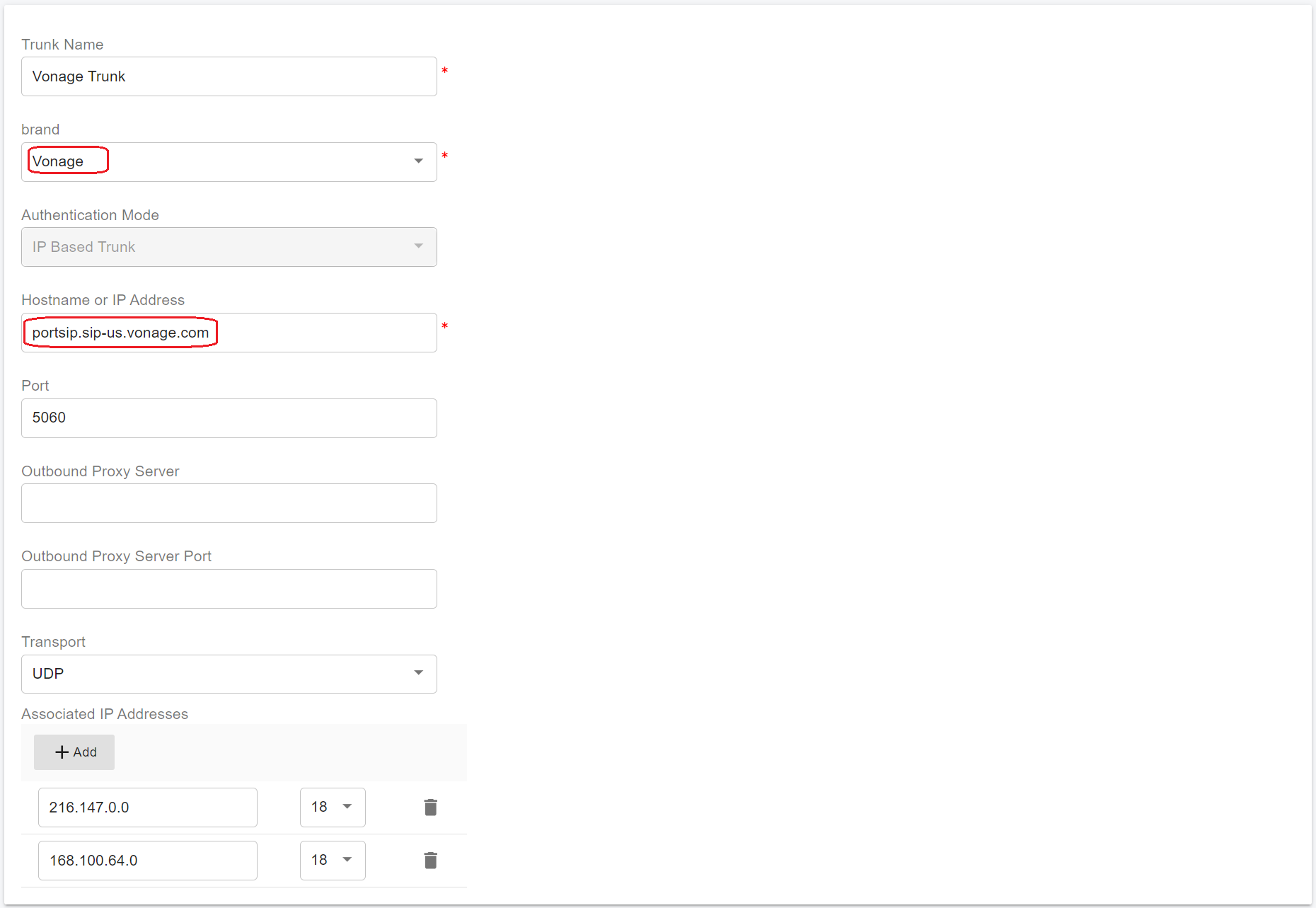
On the **Basic Settings** page, configure the following fields:
* **Name**\
Enter a friendly and descriptive name for the trunk (for example, `Vonage-IP-Trunk`).
* **Brand**\
Select **Vonage**.
* **Hostname or IP Address**\
Paste the **Vonage SIP trunk domain** copied earlier, for example:
```
portsip.sip-us.vonage.com
```
5. Click **Next** to continue.
***
#### Step 3: Configure Trunk Options
On the **Options** page:
* **Max Concurrent Calls**\
Set the maximum number of simultaneous calls allowed on this trunk.
* This value should align with your Vonage service limits and expected call volume.
* **Other Options**\
Keep the default values unless you have specific routing, codec, or interoperability requirements.
> **Recommendation**\
> For most deployments, the default options provide optimal compatibility and stability.
6. Click **Next** to proceed.
***
#### Step 4: Assign Tenants and Configure DID Pool
This step appears **only** when configuring the trunk at the **System Administrator level**.\
It is **not available** when the trunk is created at the Tenant Administrator level.
1. Assign one or more tenants that are allowed to use this trunk.
2. Configure the **DID Pool** to distribute Vonage phone numbers to tenants.
**DID Pool Rules**
* Each **DID can be assigned to only one tenant**
* Tenants can:
* Use only the DIDs in their assigned pool
* Create inbound and outbound rules using those DIDs
* Configure outbound caller ID for extensions using those DIDs
**DID Pool Format Examples**
* Single number:
```
12057494879
```
* Continuous range:
```
12057494879-12057494880
```
* Multiple entries:
```
12057494879-12057494880;12057494885
```
* Multiple ranges:
```
12057494879-12057494880;12057494890-12057494899
```
3. Click **OK** to save the configuration.
***
#### **Expected Result:**
* The trunk is successfully created.
* In the **Trunks** list, the status appears as **Online**.
> **Note**\
> For **IP-Based Trunks**, the status always displays as **Online**.\
> This is expected behavior and does **not** indicate SIP registration in the traditional sense.
***
### Next Steps
The Vonage IP Authentication Trunk is now ready for use.
You can proceed to:
* Configure outbound call routing rules
* Configure inbound DID routing
* Assign outbound caller IDs
Refer to the next guide section: [Configuring Outbound & Inbound Calls](/portsip-communications-solution/configuring-sip-trunks/vonage-sip-trunk/configuring-outbound-and-inbound-calls.md).