> For the complete documentation index, see [llms.txt](https://support.portsip.com/llms.txt). Markdown versions of documentation pages are available by appending `.md` to page URLs; this page is available as [Markdown](https://support.portsip.com/portsip-communications-solution/portsip-pbx-administration-guide/30-office-hours-and-holiday-schedule/configuring-office-hours-and-holiday-schedule.md).
# Configuring Office Hours and Holiday Schedule
**Office Hours** and **Holiday Schedules** are configured by the **Tenant Admin** in the PortSIP PBX Web Portal. Once defined, these schedules can be applied to **inbound rules** to control how calls are routed based on:
* Time of day
* Day of the week
* Selected holidays
Using schedules, you can route inbound calls to different destinations—such as **Virtual Receptionists (Auto Attendants)**, **Call Queues**, or **individual users**—ensuring calls are handled appropriately during business hours, after hours, and on holidays.
***
### Office Hours
Office hours define your organization’s **working time periods**.
* You can configure **one or more shifts** based on your business requirements.
* A **shift** represents a continuous period of time that the system treats as **working hours**.
* Any time outside defined shifts is considered **non-working hours**.
Office hours can be applied globally, per rule, or per user to support flexible routing behavior.
***
### Holiday Lists
Holiday lists define **non-working days** for your organization.
* You can create one or more **holiday lists** based on regional, national, or company-specific holidays.
* Holidays can be applied globally or selectively to rules and users.
* During holidays, calls can be routed differently (for example, to voicemail, an IVR, or an after-hours queue).
***
### Schedule Scope and Usage
PortSIP PBX supports office hours and holidays at multiple levels, allowing precise control over call routing behavior.
#### Office Hours
* **Global Office Hours**\
Defined at the **tenant level**, global office hours can be referenced by:
* Inbound rules
* Outbound rules
* Users\
This provides a consistent default schedule across the tenant.
* **Inbound & Outbound Rule Office Hours**\
You can define **rule-specific office hours** for inbound or outbound rules, overriding the global office hours for that rule only.
* **User Office Hours**\
You can define **user-specific office hours**, allowing individual users to follow a schedule different from the tenant’s global office hours.
#### Holidays
* **Global Holidays**\
Defined at the **tenant level**, global holidays can be used by:
* Inbound rules
* Outbound rules
* Users\
This ensures consistent holiday handling across the organization.
* **Inbound & Outbound Rule Holidays**\
You can select one or more holidays from the **Global Holiday List** and apply them to a specific inbound or outbound rule.
* **User Holidays**\
You can assign holidays directly to users and also select from the **Global Holiday List**, allowing user-level holiday customization.
***
### Configuring Global Office Hours
Global Office Hours define the **default business hours** for the entire tenant. These hours can be referenced by **users**, **inbound rules**, and **outbound rules** to control time-based call routing.
#### Procedure: Create Global Office Hours
1. Sign in to the PortSIP PBX Web Portal as a **Tenant Admin**.
2. From the menu, go to **Company > Office Hours**.
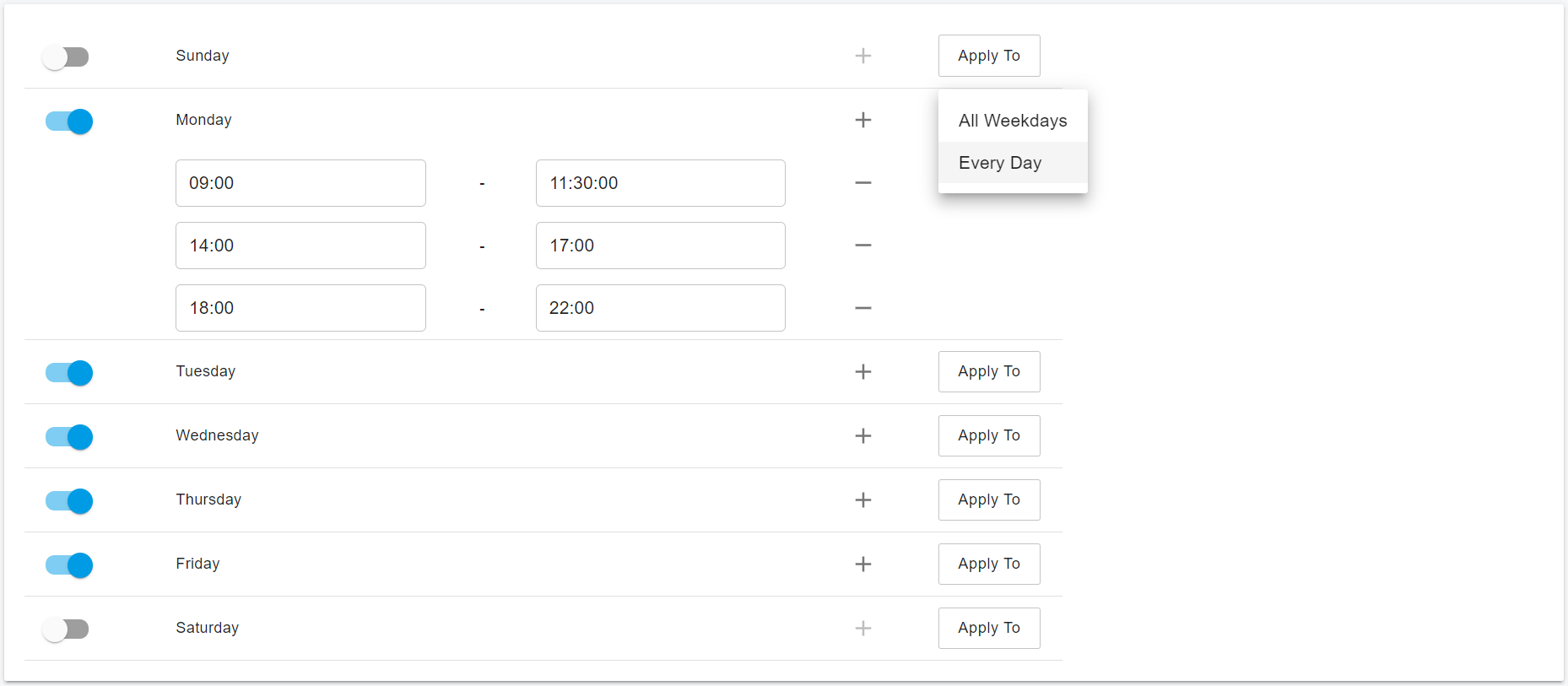
3. In the **Office Hours** section, configure one or more **shifts** for each day:
* A **shift** represents a continuous period of working time (for example, 09:00–12:00 and 13:00–18:00).
4. Use the **Apply To** button to apply the configured shifts to:
* All days, or
* Weekdays only.
#### Office hours behavior
* If a **day is turned off**, the office is considered **closed for the entire day**.
* If a **day is turned on but no shifts are defined**, the entire day is treated as **office hours**.
* If **one or more shifts** are defined, only those time periods are treated as office hours; all other times are considered non-working hours.
#### Usage
Once configured, **Global Office Hours** can be selected and used by:
* **Users**
* **Inbound rules**
* **Outbound rules**
This provides a consistent default schedule for time-based call routing across the tenant.
***
### Configuring the Global Holiday List
The **Global Holiday List** defines non-working days or periods for the entire tenant. These holidays can be referenced by **users**, **inbound rules**, and **outbound rules** to control call routing during holidays.
#### Procedure: Create global holidays
1. Sign in to the PortSIP PBX Web Portal as a **Tenant Admin**.
2. From the menu, go to **Company > Office Hours**.
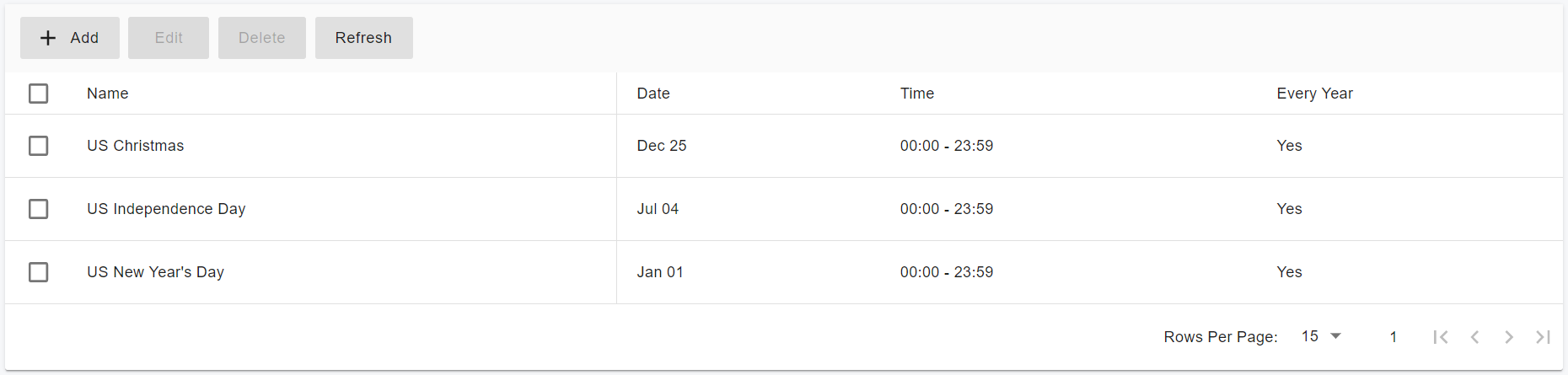
3. In the **Holidays** section, create one or more holidays:
* Assign each holiday a **friendly name** to make it easy to identify and reuse.
4. Define the holiday period:
* A **specific time range within a single day**, or
* A **continuous range of days**
5. Specify whether the holiday applies:
* To a **specific year**, or
* **Every year** (for recurring holidays).
#### Usage
Once created, holidays in the **Global Holiday List** can be selected and applied by:
* **Users**
* **Inbound rules**
* **Outbound rules**
When a holiday is applied, call routing follows the holiday behavior defined in the associated rule or user configuration.
***
### Configuring User Office Hours
User Office Hours allow you to define when a specific user is considered **available** for call routing. These hours can follow the tenant’s global schedule or be customized for individual users.
#### Procedure: Create or modify user office hours
1. Sign in to the PortSIP PBX Web Portal as a **Tenant Admin** or as the **user**.
2. From the menu, go to **Call Manager > Users > Office Hours**.
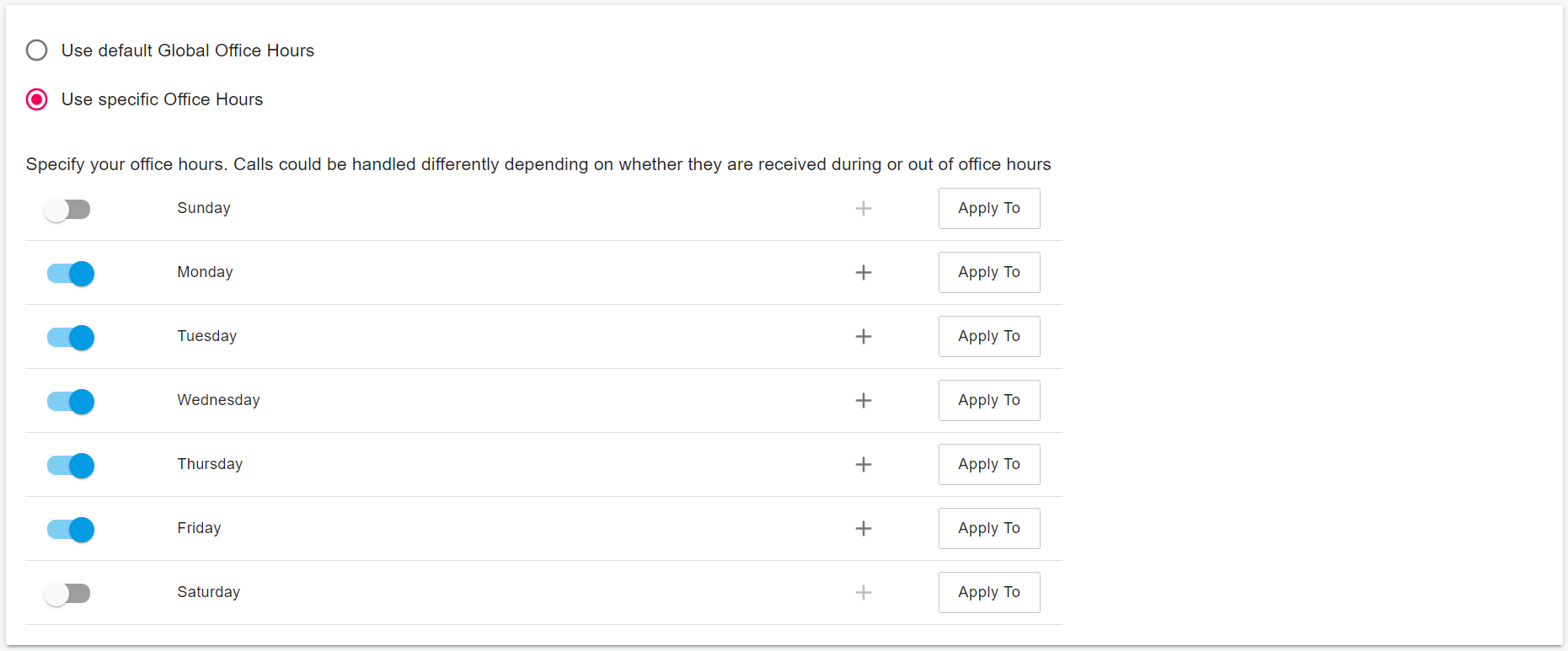
3. Choose how the user’s office hours are defined:
* **Use Default Global Office Hours**\
The user follows the tenant’s **Global Office Hours**. This is the default setting.
* **Use Specific Office Hours**\
Define **custom office hours** that apply only to this user.
#### Usage
* User Office Hours can be used by inbound and outbound rules to determine how calls are routed to or from the user.
* When **Use Specific Office Hours** is selected, the user’s schedule overrides the global office hours for that user.
***
### Configuring User Holiday List
User Holidays allow you to define **non-working days** for individual users. These holidays can include both **tenant-wide holidays** and **user-specific personal holidays**, and are used to control call routing behavior for that user.
#### Procedure: Configure holidays for a user
1. Sign in to the PortSIP PBX Web Portal as a **Tenant Admin** or as the **user**.
2. Go to **Call Manager > Users**, select the user you want to configure, and open the **Office Hours** tab.
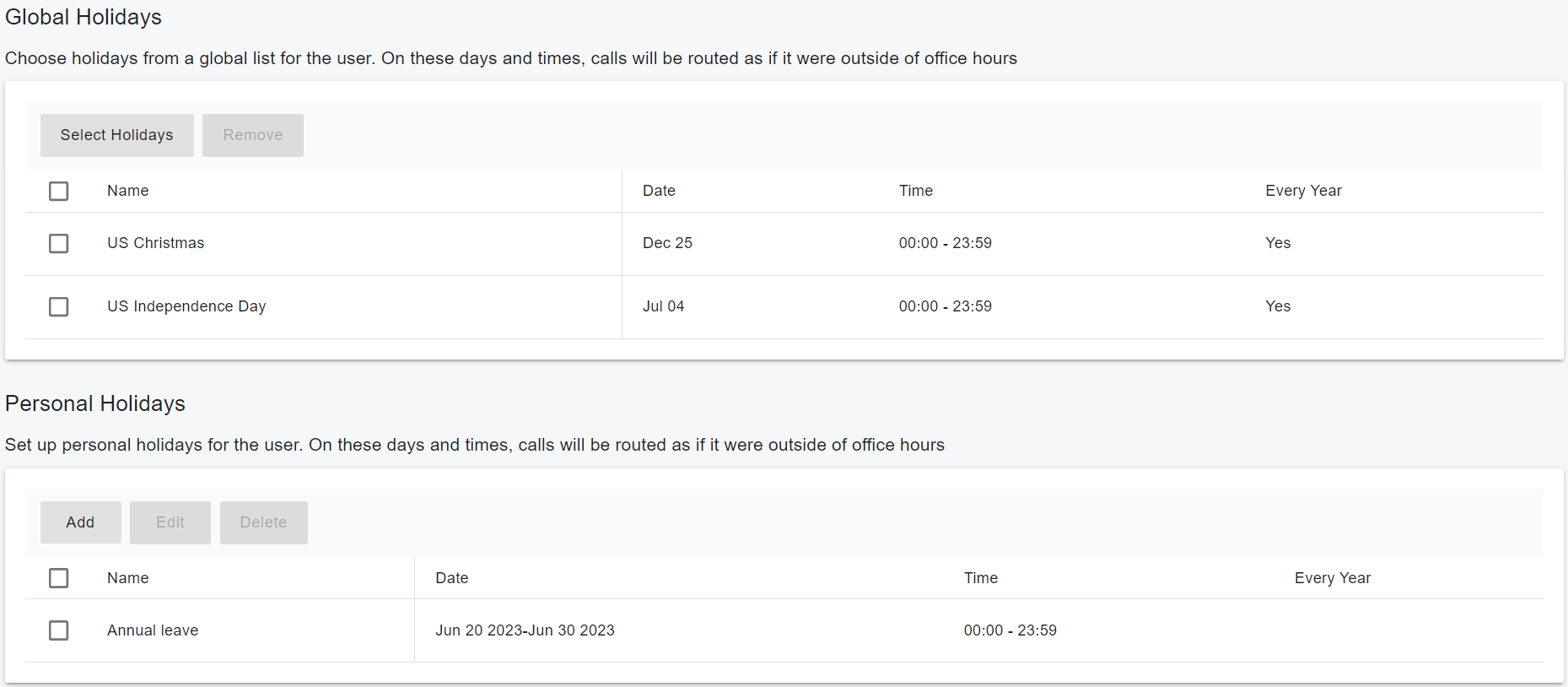
3. Configure the user’s holidays:
* **Global Holidays**\
Select one or more holidays from the **Global Holiday List** to apply to this user.
* **Personal Holidays**\
Define **custom holidays** specific to the user, such as annual leave or personal time off.
#### Holiday behavior
* Both **selected Global Holidays** and **Personal Holidays** are treated as the user’s holidays.
* During these holidays, the user is considered **unavailable**, and call routing follows the holiday behavior defined in the applicable rules.