> For the complete documentation index, see [llms.txt](https://support.portsip.com/llms.txt). Markdown versions of documentation pages are available by appending `.md` to page URLs; this page is available as [Markdown](https://support.portsip.com/portsip-communications-solution/configuring-sip-trunks/voicemeup-sip-trunk/configuring-voicemeup-trunk.md).
# Configuring VoiceMeUp Trunk
Configuring the [VoiceMeUp SIP trunk](https://www.voicemeup.com/index.html) in PortSIP PBX is straightforward. Follow the steps below to complete the setup.
***
### Prerequisite: Sign Up and Purchase DID Numbers
Before configuring the trunk, you must contact **VoiceMeUp** to create an account and purchase DID numbers.
After signup, you will typically receive the following credentials:
* **Trunk Username** – Used for SIP authentication with the VoiceMeUp trunk
* **Trunk Password** – Used for SIP authentication with the VoiceMeUp trunk
Keep these details available—you will need them during trunk configuration.
***
### Configure the VoiceMeUp Trunk in PortSIP PBX
VoiceMeUp SIP trunks are configured as **Register-Based Trunks** in PortSIP PBX.\
You can configure the trunk at either level:
* **System Administrator level**
* The trunk can be **shared with one or more tenants**
* **Tenant Administrator level**
* The trunk can be used **only by that tenant**
***
#### Step 1: Create a Register-Based Trunk
1. Sign in to the **PortSIP PBX Web Portal** as a **System Administrator** or **Tenant Admin**.
2. From the left-hand navigation menu, go to:\
**Call Manager > Trunks**
3. Click **Add**.
4. From the menu, select **Register Based Trunk**.
***
#### Step 2: Configure Basic Trunk Settings
Enter the following information:
* **Name**\
Enter a friendly name for the trunk\
(for example, *VoiceMeUp-Trunk*).
* **Brand**\
Select **VoiceMeUp**.
* **DID Pool** *(Tenant Admin level only)*
* Configure the VoiceMeUp DID numbers assigned to this tenant.
* The tenant can use **only the DIDs in this DID Pool** to:
* Create inbound rules
* Create outbound rules
* Configure outbound caller ID for extensions
**DID Pool format examples:**
```
16468097065
16468097065-16468097066
16468097065-16468097066;16468097069
16468097065-16468097066;16468097070-16468097080
```
5. Click **Next**.
***
#### Step 3: Configure Trunk Credentials
1. Enter the authentication details provided by VoiceMeUp:
* **Authentication Name**\
Enter the **VoiceMeUp trunk username**.
* **Password**\
Enter the **VoiceMeUp trunk password**.
2. Click **Next**.
***
#### Step 4: Configure Trunk Options
1. Review the trunk options.
2. Configure the following field if required:
* **Max Concurrent Calls**\
Sets the maximum number of simultaneous calls PortSIP PBX can establish using this trunk.\
Adjust this value according to your service agreement with VoiceMeUp.
> **Best Practice**\
> Keep all other options at their default values unless VoiceMeUp has provided specific requirements.
3. Click **Next**.
***
#### Step 5: Assign Tenants and DID Pool (System Admin Only)
This step is **available only when configuring the trunk at the System Administrator level**.
1. Select one or more **tenants** to grant access to the trunk.
2. Configure the **DID Pool** for each tenant.
> **Important**
>
> * Each DID can be assigned to **only one tenant**.
> * A tenant can use **only the DIDs in its assigned DID Pool**.
**DID Pool format examples:**
```
16468097065
16468097065;16468097066
16468097065-16468097066;16468097069
16468097065-16468097066;16468097070-16468097080
```
3. Click **OK** to save the configuration.
***
#### Expected Result
* The VoiceMeUp trunk is successfully created.
* Once PortSIP PBX registers with the VoiceMeUp platform, the trunk status displays as **Online** on the trunk list page.
***
### Adjust Outbound Parameters for the VoiceMeUp Trunk
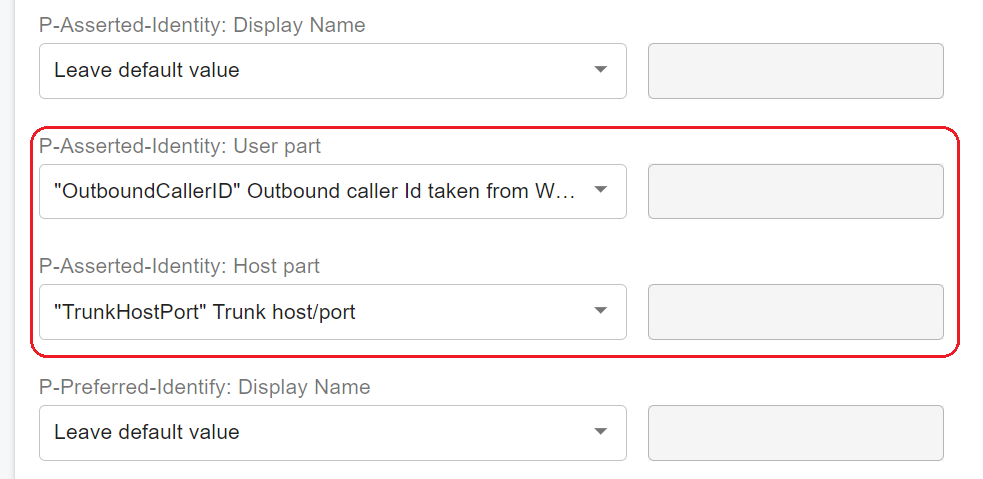
For outbound calls, VoiceMeUp requires specific SIP header mappings to ensure correct caller ID presentation. Review and configure these settings carefully.
***
#### Step 1: Configure Outbound Parameters
1. In the **PortSIP PBX Web Portal**, navigate to **Call Manager > Trunks**.
2. **Double-click** the configured **VoiceMeUp trunk**.
3. Open the **Outbound Parameters** tab.
4. Configure the following fields:
**Contact: User part**
* Choose `OutboundCallerID`\
*(Outbound caller ID taken from the Web Portal)*
**From: User part**
* Choose `OutboundCallerID`\
*(Outbound caller ID taken from the Web Portal)*
**P-Asserted-Identity: User part**
* Choose `OutboundCallerID`\
*(Outbound caller ID taken from the Web Portal)*
**P-Asserted-Identity: Host part**
* Choose `TrunkHostPort`\
*(Trunk host and port information)*
***
### Set Up Outbound Caller ID (CLI)
VoiceMeUp requires the **CLI (outbound caller ID)** to be in **E.164 format**.
#### Requirements
* The outbound caller ID **must be prefixed with `+`**
* Example:
```
+16468097065
```
When configuring the outbound caller ID for an extension in PortSIP PBX, ensure the number follows this format.
***
### Next Steps
The Bandwidth Register Authentication Trunk is now ready for use.
You can proceed to:
* Configure outbound call routing rules
* Configure inbound DID routing
* Assign outbound caller IDs
Refer to the next guide: [Route Management](/portsip-communications-solution/portsip-pbx-administration-guide/8-call-route-management.md).